

Talk to Dr. Chafetz now : 469-233-5566
Paul K. Chafetz, PhD Clinical Psychology
  • Home
  • Services
  • About
  • Contact
    • Send Dr. Chafetz a Message
    • Contact Information
    • New patient registration forms
    • Site Map
  • Blog
  • Home
  • Services
  • About
  • Contact
    • Send Dr. Chafetz a Message
    • Contact Information
    • New patient registration forms
    • Site Map
  • Blog
Picture

Whose words do you quote?

8/6/2018

0 Comments

 
I often quote the words of other people. 
Do you? 
Why do we do this? 
Who quotes your words?

In this week's video, I discuss these questions.
0 Comments

Listening to Pain

7/22/2018

1 Comment


Patients often comment how difficult it must be for psychologists to "listen to people's troubles all day."

In this week's video, I discuss why I willingly listen to people's pain. 

Check it out, then let's chat about how we can work together.

1 Comment

Do you know anyone like Sharon?

7/9/2018

0 Comments

 
Sharon's mother has been difficult forever. Sharon has negative feelings about herself and a hard time keeping friends.
Is there a connection?
0 Comments

Emotional Closeness

6/25/2018

0 Comments

 
People differ in how much emotional closeness they want with their significant other. 
In this week's vlog, I discuss how the degree of emotional closeness we have can affect our happiness.​

0 Comments

Are you like Phil?

6/10/2018

0 Comments

 
This week's video is about Phil, who has struggled with a difficult father all of his life. As a result, Phil has had trouble relating to certain other people, too.
​

If Phil's dilemma sounds familiar to you, we should talk.
0 Comments

AAAce your next job interview

5/29/2018

1 Comment


Helping people through life's transitions is not just my job, but truly my passion.  

I recently told a client who was making a career change and was nervous over an upcoming job interview about a strategy that would help them ace the interview. That session inspired this week's video. 

​If you are (or know someone who is) looking to land a new job, check out this video.

1 Comment

Are you like Denise?

5/12/2018

0 Comments

 
In this week's video, I describe Denise*, whose pleasant mom has become difficult with the onset of dementia.
​
If Denise's dilemma sounds familiar to you, we should talk.

*Not to be confused with Clarisse, discussed in my previous vlog!
0 Comments

Do you know someone like Clarisse?

4/29/2018

0 Comments


In this week's video, I describe Clarisse.

If Clarisse's dilemma sounds familiar to you, we should talk!

0 Comments

DrChafetz VLOG: The "Sudden Insight" Effect

4/15/2018

0 Comments

 
Have you ever realized something about your life or work, even though it had been true for many years? I did!

In this week's video, I reflect on the moment I coined the term CODOP, for Children of Difficult Older Parents, and became inspired to write my book, "Loving Hard-to-Love Parents."

Watch this weeks vlog about that moment of "sudden insight." Perhaps a new insight awaits you


0 Comments

Grow into it vlog: Guiding Principles

4/2/2018

0 Comments

 
In this week's vlog,  I describe how a loved one's impairment calls for adjustments to your guiding principals.
0 Comments

Grow into it vlog: Naming Your Emotions

3/19/2018

1 Comment


Can you accurately describe how you feel?

To understand or discuss any topic fully, we need words. To grow psychologically, we must strengthen our emotional vocabulary. 

1 Comment

Grow Into It Vlog: Avoiding Pointless Confrontations

3/4/2018

0 Comments

 
Do you have a difficult person in your life? This week's vlog discusses my time-tested two-part recipe for avoiding pointless confrontation with an unreasonable person.
0 Comments

Vlog: Personality Disorders

2/19/2018

0 Comments

 
This week's vlog highlights a concept I discuss in my book: personality disorders. People with a personality disorder look and act in most ways like everyone else, yet they can cause serious pain to those closest to them.

To learn more about this "pathology masquerading as normalcy," watch this week's vlog.
0 Comments

Vlog: Being your best self

2/2/2018

1 Comment


Do you have any traits of a difficult person?

My book, "Loving Hard-To-Love Parents," offers two strategies for becoming your best self at any age.

​Watch this week's YouTube vlog to learn about them!

1 Comment

Vlog: Do you know a difficult person?

1/22/2018

0 Comments

 
If you have a difficult relative, you probably have a history of repetitive and unproductive conversations with them. Watch this week's YouTube vlog to learn how to be a "smarter fish" and not take the bait!

https://youtu.be/Va6zJ9zoTDI
0 Comments

Dr. Paul's new Vlog

1/21/2018

0 Comments


I am happy to announce that I will be starting a new video blog series on my  YouTube channel. Visit my YouTube channel to see my first of many vlogs.
0 Comments

LEARN TO BE A DIFFICULT OLDER PARENT IN TEN EASY STEPS

12/18/2017

1 Comment

 
Picture

It's the season of giving!   I'd like to gift you a lasting value idea.   Here is a gift that truly keeps giving....

Have you known any difficult older parents and secretly admired them? Have you always hoped to be a difficult older parent yourself, but somehow not yet succeeded?  If so, do not despair! This goal is still within reach. Here are ten easy strategies to help YOU become a difficult older parent:

1. START EARLY. You will leave much deeper impressions on your children if you start when they are very young. Capitalize on the natural readiness of healthy children to love, trust, and admire their parents, and their almost total lack of natural defenses against difficult parents.

2. START WITH THE BASICS. Practice being angry, arrogant, callous, critical, entitled, intrusive, irrational, sarcastic, and selfish. After mastering these, you can move on to more advanced skills.

3. DIVERSIFY YOUR APPROACH. Be creative. For example:
   a. Never stand on ceremony, even if your kids call you intrusive
   b. Be open and honest about who your favorites are and aren’t  
   c. Speak your truth, even if it hurts their feelings in the present
   d.  Share your wisdom about life often, even if unappreciated in the moment
   e. Make your own decisions about whom to trust with your important decisions, even if your kids call you gullible or irresponsible

4. RISE ABOVE MERE FACTS. Don’t let the truth stand in the way of a compelling story. Make liberal use of lies, innuendo, and hypocrisy.

5. ESTABLISH USEFUL BOUNDARIES. Insist that your adult children tell you everything you ask them, but also protect the family’s privacy (secrecy) against outsiders.

6. INVOLVE YOUR COMMUNITY. Share your disapproval of your adult children with friends. After all, it is not gossip if it is true, is it?

7. CLAIM YOUR RIGHTS. Tell your children that they owe you respect and tolerance because you raised them.

8. CELEBRATE YOUR ACHIEVEMENTS. Make sure everyone knows about your righteous efforts to fix your offspring. With a little luck, you’ll damage your kids enough to make them difficult to their kids, too.

9. BE PERSISTENT AND STEADFAST. Becoming a difficult parent takes practice. Resolve to work at it every day. Ignore distractions. Do not be moved by your children’s pitiful complaints or disrespectful accusations of you. Your feelings are more important than theirs. After all, they are now adults and no one promised them a rose garden. If they really want to achieve more peace in their relationship with you, let them find Dr. Chafetz’s book, Loving Hard-to-Love Parents: A Handbook for Adult Children of Difficult Older Parents, on their own.

​10. INVEST IN THE FUTURE. Remember to alienate your grandchildren, too.
​

1 Comment

Are You Fully Deployed?

10/15/2017

0 Comments

 
Picture

Man-made space satellites are a bit like people. They are assembled with extreme care and precision in a single-purpose environment in which they must not remain. Then, with great effort and drama, they are launched into the environment for which they were designed.

Once a satellite arrives in space orbit, it begins a slow dance of preparation for its mission. This includes the careful unfolding, or deployment, of a multi-panel array of solar cells. Although the panels left earth as a very compactly folded arrangement, they must unwind into a very wide-reaching structure. They can then collect the sun’s rays for transformation into electricity, and power the satellite as it toils to fulfill its mission. If the solar array does not fully deploy, the satellite will not be able to fulfill its mission.

Like satellites, we must each strive to fully deploy ourselves. We must stretch ourselves, exercise every ability, and embrace every healthy opportunity and appropriate risk if we are to complete our mission in life. If we want to travel further and longer in life, and be bigger and better in life, then we must intentionally spread our wings to their full extent. We must open ourselves wide, wide, wide to our reach our full potential. We must strive for full self-deployment .

How fully deployed are you?
​

0 Comments

PSYCHOTHERAPY AS HOME REMODELING

7/30/2017

13 Comments

 
Picture
The primary service of my psychology practice is individual psychotherapy. Many people call it counseling or consultation, but, by any name, the goal is to create tangible positive change in my patient’s life. In other words, to turn your challenges and dilemmas in life into building blocks of a better you.
 
Working as a therapeutic team, my patient and I accomplish this transformation by improving their psychological skills. These include self-awareness, assertiveness, courage, empathy, commitment, regulation of emotions, and clarity of values and goals.
 
Psychotherapy is very much like remodeling the most central room in your house. Let’s say you realize that your bedroom, your kitchen, or your family room simply no longer meets your needs at this stage of your life. You are keenly aware that this room must be improved for you to feel contentment and fulfillment at home. It is time to remodel.
 
Of course, updating the wiring, plumbing, or floor plan means some wallboard will have to be removed. The exposed areas are not always pretty. Likewise, the psychological skills I mentioned live in a place in us that cannot be reached formulas or by medicine, so we’re going to have to look under the social veneer we all have.  There will be dust and inconvenience, perhaps even temporary discomfort, as we grieve old losses and remove old barriers. This is how we create and bring light into new spaces.
 
Your house is not identical to anyone else’s house. Your psychological needs are not identical to anyone else’s. Therefore, every remodeling job and every psychotherapy plan is a custom project. Your house is updated by hand, one brick, stick, and nail at a time.  Your heart is healed one cry, one insight, and one courageous step at a time. We do it through a series of totally confidential conversations. It takes a little time, but the results last a lifetime. That remodeled center room in your psyche will be yours, with you wherever you go in life, forever.
 
If the center room in your psyche is not a place of contentment and fulfillment, I hope you will call me. Let’s talk about working together to keep you moving forward.

13 Comments

GROWING INTO AUTHORSHIP

7/15/2017

1 Comment

 
Picture
The creation of my new book, Loving Hard-to-Love Parents: A Handbook for Adult Children of Difficult Older Parents, has been a journey of growth for me.

The journey began in late 2015, when the concept of CODOP (adult children of difficult older parents) congealed. I realized that I had worked consistently with adult children of difficult elders since opening my practice in 1982. Despite my total immersion in this work, I did not identify it as a discreet topic with its own body of knowledge until 2015.

Many reasons supported my decision to write a book about CODOP. My own practice had seen hundreds of real families who embodied this phenomenon. Working with these families had allowed me to learn their dilemma in depth, and observe which of their approaches were helpful and which were not. The results of my passing on track-proven approaches to subsequent families validated their robust utility. Finally, it was painfully obvious that the families who came through my practice were just a sliver of the population of families who needed these approaches. For all these reasons, I resolved to write a book.

In parallel with starting the book, I began speaking about CODOP to professional and lay audiences, and holding CODOP support groups.  My confidence in the meaningfulness of the CODOP program was progressively strengthened by the strong positive response I found in these audiences.
​
Undertaking the book launched me onto a learning curve. I decided to forego the challenge of finding a publisher, and instead to self-publish. Of course, I had no idea how one does such a thing, so it was time to start exploring online and finding kind and knowledgeable people who would answer my hundreds of beginner’s questions. With their help, by fits and starts, I wrestled my new learning into this plan:
  1. Write the manuscript
  2. Choose and use a content editor
  3. Choose and use an illustrator
  4. Buy ISBNs
  5. Choose BASACC categories
  6. Write copy for the cover
  7. Choose and use a cover designer
  8. Choose and use an interior layout designer who would also convert the manuscript to into a PDF (for print copies) and into three e-book formats (for the various brands of e-book reader)
  9. Choose and use a printing firm
  10. Choose and use a vendor for print-on-demand fulfillment and e-book distribution
                                                                                                                                            
The journey included many emotions:
  1. Fears of failure and futility
  2. Excitement at the possibility of creating something useful
  3. Joy at feeling the growth of my insight into the structure and depths of the topic
  4. Fascination at the evolution of book’s structure
  5. Ultimately, after sixteen months of work, thrill at seeing the first bound copy

So, this has been my journey, my transition, into independent authorship. Like every transition, it involved learning new skills, processing many emotions, and putting in the raw work of time, effort, and money. Like everyone else in the world, I had to GROW INTO my next stage.

I have been very gratified by the book’s reception so far. There will be a gala launch party in late August at Belmont Village in Dallas.  Stay tuned here for details as the date approaches. I hope you’ll attend!

1 Comment

INDEPENDENCE DAY 2017

7/1/2017

2 Comments

 
Picture

An early step in the writing of my new book, Loving Hard-to-Love Parents: A Handbook for Adult Children of Difficult Older Parents, was a review of files of patients I had seen in my practice over the previous five years. Among these, I found dozens of cases of patients who were struggling with a difficult older parent. My notes detailed the unpleasant behaviors of these parents, and the themes running through these cases became the backbone of my book.

It was quite interesting, however, to also find files for many patients who once or still had a very difficult parent, yet had gotten quite over it and had used their psychotherapy with me to deal with another life challenge altogether. Their history with their difficult parent was old business, just another “oh, well” piece of their life tapestry. What differentiated these adults from their still-suffering peers is a very complex topic, which will probably be examined at length in my book’s eventual second edition.

What is vital to recognize right now, however, is that the very existence of such “recovered CODOPs” sends a profound message to those less fortunate, i.e., that recovery truly is attainable.

What does recovery mean for a CODOP? Apropos for Independence Day, it means emotional independence from the difficult parent and their legacy. It means emancipation, that is, termination of a former state of inequality. It means peerhood, that is, a deep sense of equal autonomy, equal authority, and equal responsibility between the parent and the adult child. It means filial maturity, that is, the mutual and caring relationship seen between adult children and their older parents, including each understanding the needs of the other.

As was the case for our national founding fathers, independence is not willingly granted by problematic rulers. The underdog has to work for it, demand it, fight for it, and refuse to accept anything less. It takes clarity, courage, and commitment. With luck, the relationship between the formerly unequal parties can eventually become as positive as that between the US and Great Britain today.

Everything I know about this process is in my book. As of this writing, copies are rolling off of the press in Dallas. Stay up to date here on how you can get your copy.

Happy Independence Day!

SEE ALSO my blog post for Independence Day last year here.

2 Comments

FATHER'S DAY 2017

6/15/2017

1 Comment

 
Picture

My father would now be 98 years old had he not passed away in 1998. He was a fine guy who had a really good life. 
His life included many wonderful aspects. These included growing up with his six siblings in a hardworking, close, and loving family, a happy marriage, four healthy, successful children, a successful business career, and a rewarding retirement period spent travelling with his wife.

His life also included many painful aspects. These included losing his father at age 14, painful deaths of various relatives through the years, and some serious health challenges in adulthood.  Although he had his personality quirks, he was almost always pleasant to everyone. He was widely respected and beloved by relatives and friends.

My father was not perfect. But parents need not be perfect. In fact, no one has perfect parents, and no one has a perfect childhood. No matter how loving, fair, healthy, and attentive your parents were, there were certainly life skills that come in handy but that your particular parents somehow failed to provide you.

If you were taught self-reliance, were you also taught generosity and sharing? If you were taught compassion, were you also taught self-respect and the ability to say no? If you were taught assertiveness, were you also taught how to observe and listen? If you were taught gratitude, were you also taught ambition? If you were taught forgiveness, were you also taught how to confront an offender?

Luckily, a child with “good enough” parenting generally turns out fine. I feel am one of these. I hope you are, too. If you are lucky enough to still have a living father, be sure you thank him properly this Father’s Day.

For anyone whose father is or was not so pleasant, I am very happy to make two important announcements. 

First, my book, Loving Hard-to-Love Parents: A Handbook for Adult Children of Difficult Older Parents, is very close to publication! It contains all of the wisdom I have gleaned from working with hundreds of such families, presented as ten concepts to empower your mind, ten insights to comfort your heart, and ten skills to guide your actions. Learn more about the book here.

Second, our free, monthly support group for adult children of difficult older parents (CODOPs) has a home! They will take place at 6:30 p.m., on the fourth Tuesday of each month at Unity Church of Dallas, 6525 Forest Lane, Dallas, TX 75230. Please join us on Tuesday, June 27 at 6:30. RSVP is requested here.
​

1 Comment

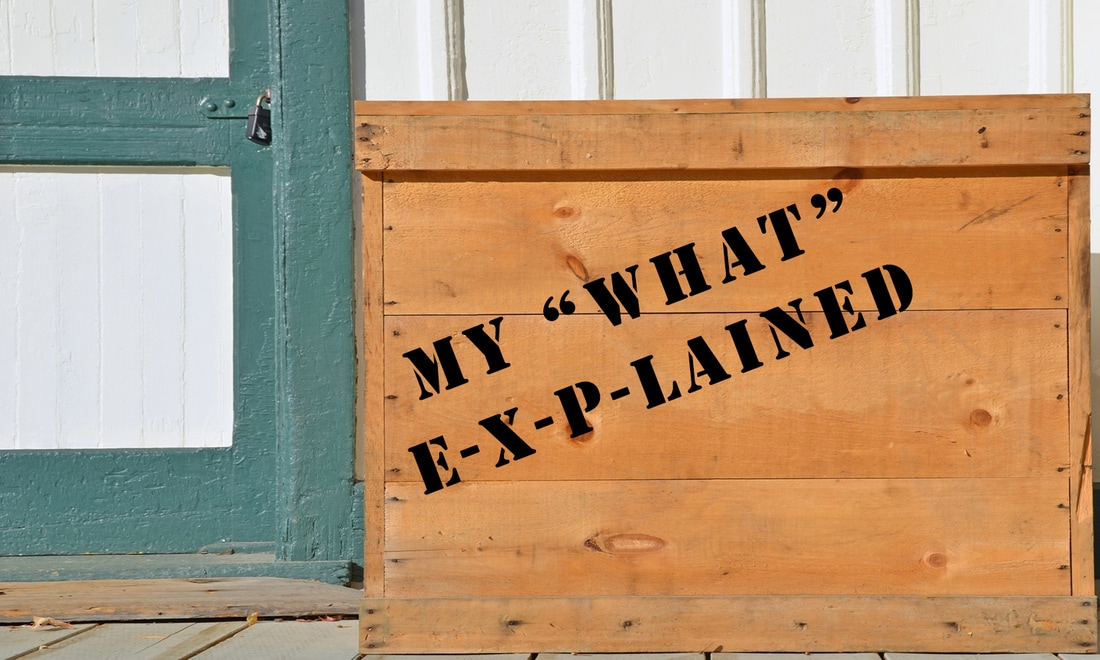
My “What,” E-x-p-lained

6/4/2017

0 Comments

 
Picture
Many readers are already familiar with Simon Sinek’s blockbuster book, Start with Why, and his excellent YouTube video about it. If you are not, Google them right now. Sinek proposes that every person and every enterprise know their why, their what, and their how.

What is my why? As I have blogged here before, my work as a psychologist is fashioned around this principle: the reason we all face so many struggles and dilemmas in life, love, and loss is so we will learn from living and grow from learning. In short, LIFE IS FOR LEARNING AND GROWING!

My what is that people can learn and grow their way into every transition and adjustment demanded of them. The right psychological concepts, insights, and skills are critical to making this possible. You could say that it is all about E-X-P! That is, many important applications of this principle are captured well by words that start with exp-.

Learning and growing involve EXPediting:
  • healthy EXPloration
  • prudent EXPerimentation
  • constructive EXPansion
  • genuine EXPeriencing
  • authentic self-EXPression

Learning and growing also involve:
  • Maintaining realistic EXPectations
  • Eliminating EXPloitation
  • EXPosing, EXPloding, and EXPunging our irrational fears and biases
  • EXPorting love and respect to everyone we know
  • Extracting meaning from everything we do

How refers to accomplishing these lofty goals through our daily activities. The how for my practice consists of the various services I provide. However, each of us also needs a how for our individual life. What specific habits do we practice to keep ourselves growing? What is your how? How do you ensure that your progress toward becoming an EXPert on yourself stays EXPonential and never EXPires?

If you want help with your why, what, or how, give me a call. What Sinek began, we will complete!

0 Comments

WHEN FRIENDSHIP KNOCKS AT THE DOOR

5/22/2017

6 Comments

 
Picture

Imagine this common scene. At a gathering, Bob sees his friend, Bill, for the first time in two months. After the handshake and hello, Bob asks Bill, “How are you doing?”

I think of this simple question from Bob to Bill as a knock on the door of the Bill’s inner life. The “space” behind this “door” is not Bill’s living room, but his private thoughts and feelings. Here are his hopes and fears. Here are his opinions of himself and others. Here are his memories and his current projects and dilemmas.

Once Bill hears the knock, he has only a split second to decide how to respond.  Will he open the door? How far will he open the door?

Let me suggest this key for deciphering Bill’s answers.

Bill might say, “Good to see you, too!  How are you?” This is equivalent to not opening the door at all for Bob at this time.

Bill might say, “I’m fine.” This is the door opening just enough to acknowledge the knock.  The chain is not removed, and the door is promptly re-closed.

Bill might say, “Pretty good,” or “OK.” This is unlocking the door, removing the chain, and opening it halfway. Halfway is open enough for Bob to see inside a little. Unless Bob asks a follow up question, the door will be closed.

Bill might say, “Good question,” or “Don’t ask,” or “I’m doing.” This is opening the door wide open, giving Bob a full view of the room inside, with all its chaos and distress. It is an invitation for Bob to follow up with another question.

Bill might say, “I’ve been better,”  “How long do you have?” or especially “Not so good.” This is not only opening the door wide but welcoming Bob inside to hear the authentic truth about Bill at this moment. If the immediate setting is not conducive, plans are made for a prompt one-on-one visit.

It is good when someone knocks on a friend’s door. It is even better when the friend lets the visitor in. Friendships are built on connection and authenticity.

How do you answer knocks on your door?

6 Comments

A MOTHERS DAY THOUGHT

5/10/2017

1 Comment

 
Picture
A Jewish proverb says, “God could not be everywhere, so he made mothers.” Parents turn the raw fruit of their wombs and loins into people. It is indeed creation. Done well, it is God-like. Done poorly, it is not pretty.

​I have seen the full range of quality in mothers.

At one extreme are the heartbreaking depictions of parenting gone wrong, which I hear about in my practice. For example:

“Mother has always been beautiful and wealthy, but unforgiving, unrelentingly demanding, rejecting, consuming, smothering, and angry. She never once told me she loved me. Dad married her for her beauty and learned fast to keep his head down.”

“Mom was impossible. Incredibly selfish and mean, she abused us mentally and physically. She was secretive but expected us to read her mind. We often got the silent treatment, knowing she was unhappy with us but not knowing why or how to fix it. There were frequent spankings. She teased us and would humiliate us in front of others. She had no friends, but ruled our home totally.”

At the other extreme are the many wonderful mothers I have been blessed to observe in my own family and in my circle of friends. These women have been or still are beloved and respected both within and beyond their immediate families for their wisdom, kindness, stability, and hard work.

There is also a middle ground. Children do not need perfect parenting. They just need good-enough parenting. Given the basics, the sufficient minimum, a growing child can finish the job on their own, albeit often with the help of additional adults found along the way.

A 2009 post by Tim Sanford titled The Real Job of Moms on the website, focusonthefamily.com, describes this concept well. I paraphrase it here:

“What is a mom's primary job? The most important assignment a mom has is to nurture her children. This means enabling them to develop fully by pouring life into them. She models joy and passion. Nurturing is filling your child up with aliveness.

A nurturing mom takes time to play, read, and take pictures when the toddler's spaghetti ends up on the head instead of in the mouth. She enters the child's world to see things from his or her perspective. She provides empathetic understanding from a position of strength and support. She finds balance between the healthy desire to give kids freedom and the God-given urge to keep them safe.

Nurturing is not about ‘doing it all’ or doing it perfectly. It's about doing the best you can — without losing yourself or driving yourself crazy. You can't control the results, but you can stir in the right ingredients. You can seek to know your children as individuals, different as they might be, and bring out the best in each.”
​
Happy Mothers Day!
1 Comment
<<Previous
Forward>>
    My podcasts

    Dr. Chafetz

    “My passion is ensuring that every adult is mentally ready to succeed in all transitions that comprise the adult years.  The meaning in my life comes from helping my patients see themselves, their situation, their future, and the entire world with new eyes and a newly courageous attitude.  
    ​
    My blog is for those wanting to Grow Into It."

    RSS Feed

Powered by Create your own unique website with customizable templates.
